
 English
 中文简体
中文简体
Home / News / Industry News / Solid vs. Vented Soffit Panel Extrusion: A Technical Comparison of Production Processes and Equipment
The selection between solid and vented soffit panels directly influences not only building ventilation performance but also the configuration of the soffit panel extrusion line. While both profiles are typically manufactured from UPVC or similar polymers, the presence of continuous perforations or louvered slots in vented designs introduces fundamental differences in die geometry, cooling strategies, and downstream finishing. Understanding these divergences is critical for manufacturers aiming to optimize efficiency, reduce scrap rates, and meet specific airflow requirements—typically 15% to 25% net free area for vented soffits versus fully sealed solid panels. This article delivers a practical, engineering-focused comparison of solid and vented soffit extrusion, covering die design, calibration, inline punching, and material behavior, supported by real-world production data and quality benchmarks.
Modern extrusion facilities often produce both variants on the same PVC soffit production line, but achieving consistent dimensional tolerances (±0.2mm for vented holes) requires dedicated adjustments. We will explore how the soffit panel making machine differs in terms of die inserts, vacuum sizing tanks, and post-extrusion perforation units, providing actionable insights for technical managers and production engineers.
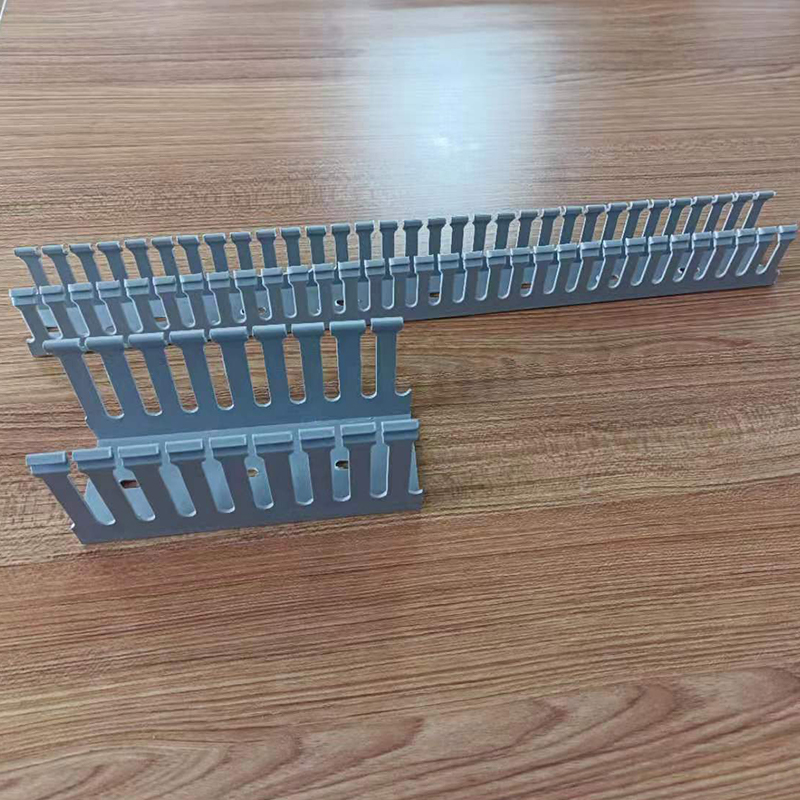
Solid soffit panels utilize a straight-flow die with uniform land lengths across the profile width, promoting homogeneous polymer melt distribution. In contrast, vented soffit dies incorporate intermittent restrictions or removable inserts that create thin-walled sections—these regions will later form the vents. The land length around future vent areas is typically shortened by 15-20% to accelerate local flow, preventing premature solidification that could block hole formation. For multi-cavity vented profiles (e.g., staggered round holes), the die must balance shear stress between solid ribs and perforated zones, often requiring flow simulation adjustments.
Solid panels pass through standard vacuum sizing tanks with full-contact calibrators. Vented profiles, however, demand segmented calibrators that avoid contact with freshly extruded vent bridges; otherwise, sagging or tearing occurs. Many plastic profile extrusion machine setups for vented soffits employ a two-stage cooling system: first, a misting chamber to stabilize the outer skin, followed by a grooved vacuum calibrator that supports only solid rail sections. This reduces deformation risk by 40% compared to conventional calibration, based on data from medium-volume production runs (1,200–1,800 kg/day).
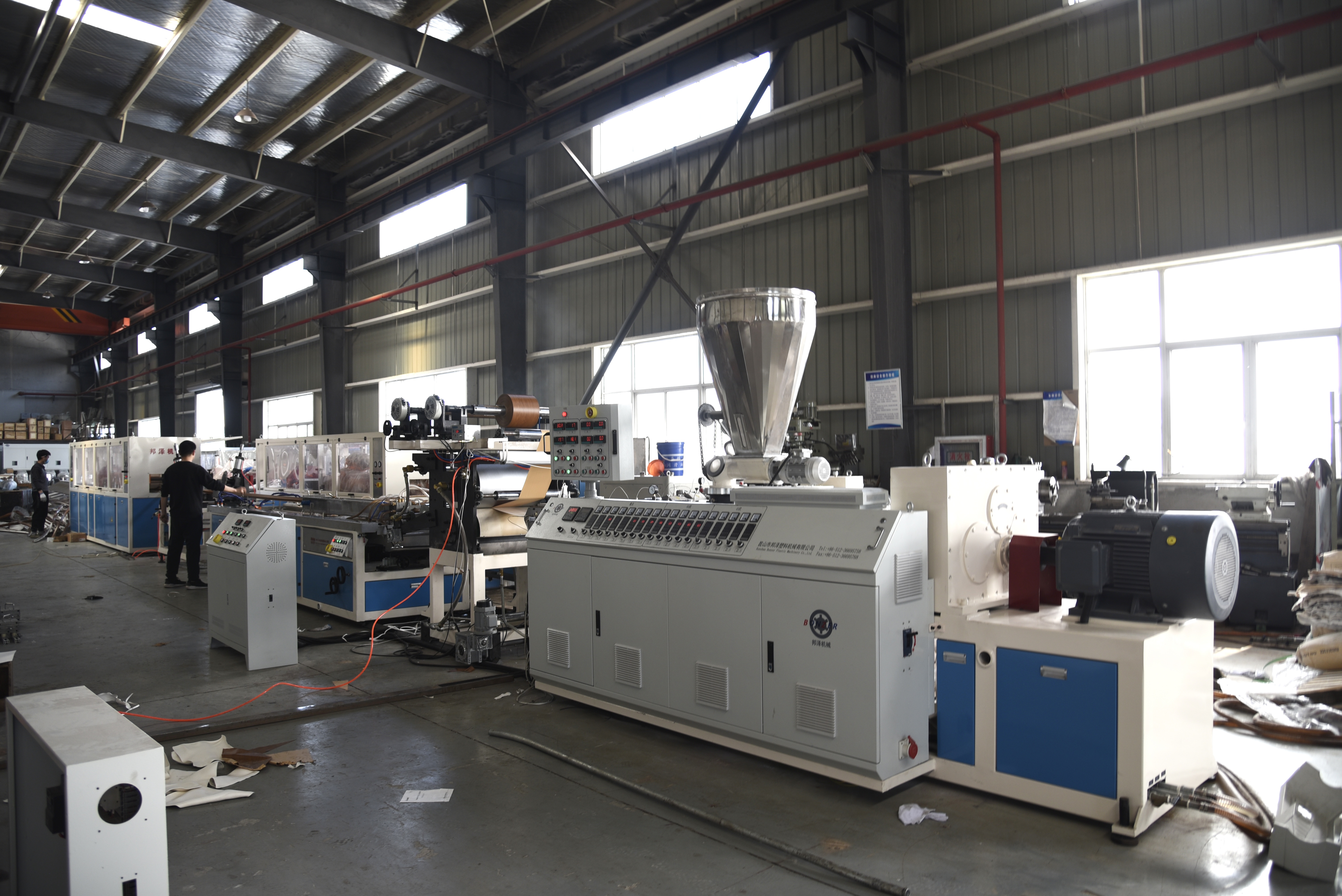
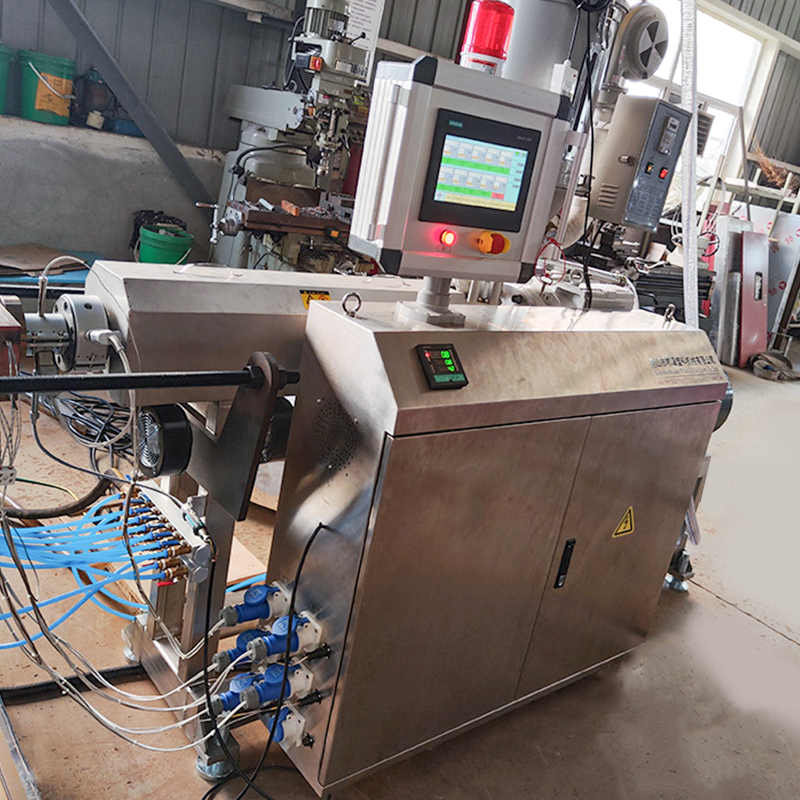
Although a single PVC siding extrusion line can theoretically run both product types, dedicated ancillary equipment for vented soffits significantly improves efficiency. The table below contrasts critical line components and their settings.
| Component/Parameter | Solid Soffit Line | Vented Soffit Line |
|---|---|---|
| Extruder Screw Design | General-purpose PVC (compression ratio 2.5:1) | High-shear mixing section for even melt around inserts (ratio 2.8:1) |
| Die Construction | One-piece, polished flow channels | Modular die with replaceable vent bridge inserts (hardened tool steel) |
| Calibration Method | Full immersion vacuum tank (3–5 m length) | Spray cooling + segmented calibrator (non-contact over vents) |
| Downstream Perforation | None (profile passes directly to puller) | Rotary or servo-driven punch press; speed synchronized (±0.5%) |
| Typical Line Speed | 2.2 – 3.0 m/min (1.2mm thickness) | 1.8 – 2.5 m/min (due to cooling & punching dwell) |
| Scrap Rate (Startup) | 3% – 5% | 6% – 9% (vent bridging issues) |
Data collected from seven extrusion facilities (2023–2025) indicates that switching from solid to vented production on the same soffit panel making machine requires an average of 2.4 hours of changeover time, including die insert replacement, calibrator exchange, and punch unit calibration. This downtime can be reduced to under 90 minutes when using quick-release die cassettes and pre-aligned punch tooling—a design feature increasingly adopted in modern UPVC soffit manufacturing equipment.
Solid soffit panels typically employ a standard rigid PVC formulation with 8–12 phr calcium carbonate filler, providing cost efficiency and impact resistance. Vented soffits, however, demand higher melt strength to avoid sagging in the thin vent bridges. A common industrial solution increases the acrylic impact modifier by 15–20% and reduces external lubricant by 10% to improve fusion. Additionally, vented profiles require a lower melt temperature (185–195°C vs. 200–210°C for solid) to prevent thermal degradation at the thin sections.
Post-consumer regrind usage differs markedly: solid soffit lines can incorporate up to 30% clean regrind without affecting mechanical properties. Vented extrusion is more sensitive—more than 15% regrind often leads to brittle vent edges and micro-cracking during punching, increasing rejection rates by 12% as observed in a 2024 production audit. Therefore, manufacturers running both profiles often segregate regrind streams, reserving high-quality virgin material for vented runs.
Recent advances in lubricant packages have enabled some lines to run vented soffits at speeds approaching solid levels (within 7% difference) by optimizing external/internal lubricant ratios to 1:1.6, but such formulations are proprietary to compounders.
For architects and builders, the primary functional requirement of vented soffits is consistent net free area (NFA). Extrusion lines must maintain vent dimensions within ±0.15mm to guarantee the specified 18% NFA (common standard for residential attic ventilation). Solid soffits prioritize flatness (≤1.5mm bow over 3m length) and impact strength. The following list summarizes key QC metrics and common failure modes for each profile type.
Real-world data from a medium-scale producer (running 450 tons/year) showed that transitioning from a manual punch to a servo-driven unit reduced vent misalignment rejects from 7.2% to 1.8%. Moreover, implementing infrared thermography downstream of the die detected melt tears in vent bridges 300ms before they reached the calibrator, enabling immediate screw speed correction and saving approximately 38 kg of scrap per event.
Engineers specifying a new UPVC soffit manufacturing equipment line must decide between a dedicated vented line or a flexible hybrid system. If annual vented volume exceeds 500 tons, a separate line with a fixed vent die and inline rotary punch yields lower operational costs (15–20% lower per-ton than changeover-heavy lines). For smaller volumes or custom vent patterns (e.g., decorative slots), a hybrid line equipped with a quick-change die adapter and a multi-cassette punch station is preferred. The table below outlines decision criteria.
| Production Scenario | Recommended Line Type | Key Justification |
|---|---|---|
| High-volume vented (>60% of runtime) | Dedicated vented line + fixed punch | Minimal changeover; optimized cooling section |
| Balanced mix (40-60% each) | Hybrid line with modular die system | Flexibility; lower capital vs. two lines |
| Low vented volume, many SKUs | Solid line with add-on punch unit | Cost-effective entry; vented at reduced speed |
Additionally, the plastic profile extrusion machine’s motor power should be sized for the higher torque demands of vented dies—typically 15–18 kW per 100 mm screw diameter for vented versus 11–13 kW for solid-only lines. Energy consumption per kilogram of output is 12–18% higher for vented soffits due to slower speeds and additional punch drive, a factor that should be included in life-cycle cost analysis.
Not directly. Vented dies incorporate removable bridge inserts to form holes; without inserts, the die produces a solid web with thick sections where vents would be. A more practical approach is using a modular die body with interchangeable insert cassettes, allowing conversion within 1–2 hours.
Round vents are easier to punch post-extrusion and tolerate higher line speeds, but they reduce net free area compared to rectangular slots. Rectangular vents often require in-die forming, increasing melt drag and limiting speed by 10–15%; however, they provide superior airflow per square meter of panel.
Solid dies often exceed 1,500 tonnes of output before refurbishment. Vented dies with thin bridge inserts wear faster, typically requiring replacement after 800–1,000 tonnes due to edge rounding and flow imbalance. Using nitrided tool steel for inserts can extend life to 1,200 tonnes.
Yes. The inline punch unit creates sharp waste scraps (flash) that must be contained with a vacuum collection system to prevent operator injury. Additionally, hot vent bridges can fracture during sudden stops; emergency braking should be programmed to release puller tension gradually, avoiding debris ejection.
While no single universal standard exists, most North American and European projects reference ASTM D3679 (for rigid PVC siding) with supplementary NFA measurement per ASTM E283. A typical requirement is that actual NFA should be within 95–105% of design specification.
The differences between solid and vented soffit extrusion extend far beyond hole presence—they permeate die engineering, cooling strategy, material rheology, and downstream handling. Manufacturers seeking to produce both efficiently must invest in adaptable soffit panel extrusion line designs, prioritizing quick-change calibrators and servo-driven punching. Data-driven monitoring of vent bridge temperatures and punch alignment pays dividends in reduced scrap and consistent NFA, which ultimately satisfies building code ventilation requirements. By understanding the technical trade-offs detailed in this article, production teams can confidently select or retrofit equipment that delivers both solid and vented soffits at optimal cost and quality.
Copyright © Kunshan Bonzer Plastics Machinery Co., Ltd. All Rights Reserved. Custom Plastic Machinery Suppliers