
 English
 中文简体
中文简体
Home / News / Industry News / How Does the Extrusion Process Enable Deeper, Sharper Woodgrain Embossing on Soffit Panels?
In the world of architectural building materials, aesthetics are just as critical as performance. For soffit panels, the ability to replicate the authentic, rich texture of natural wood has become a paramount concern for homeowners, contractors, and wholesalers alike. While many manufacturing methods can apply a woodgrain pattern, not all are created equal. The depth, sharpness, and consistency of the embossing are what separate a convincing replica from a cheap imitation. This level of quality is not achieved by chance; it is engineered through a precise and sophisticated manufacturing process. The key to unlocking this high-fidelity aesthetic lies within the soffit panel extrusion line.
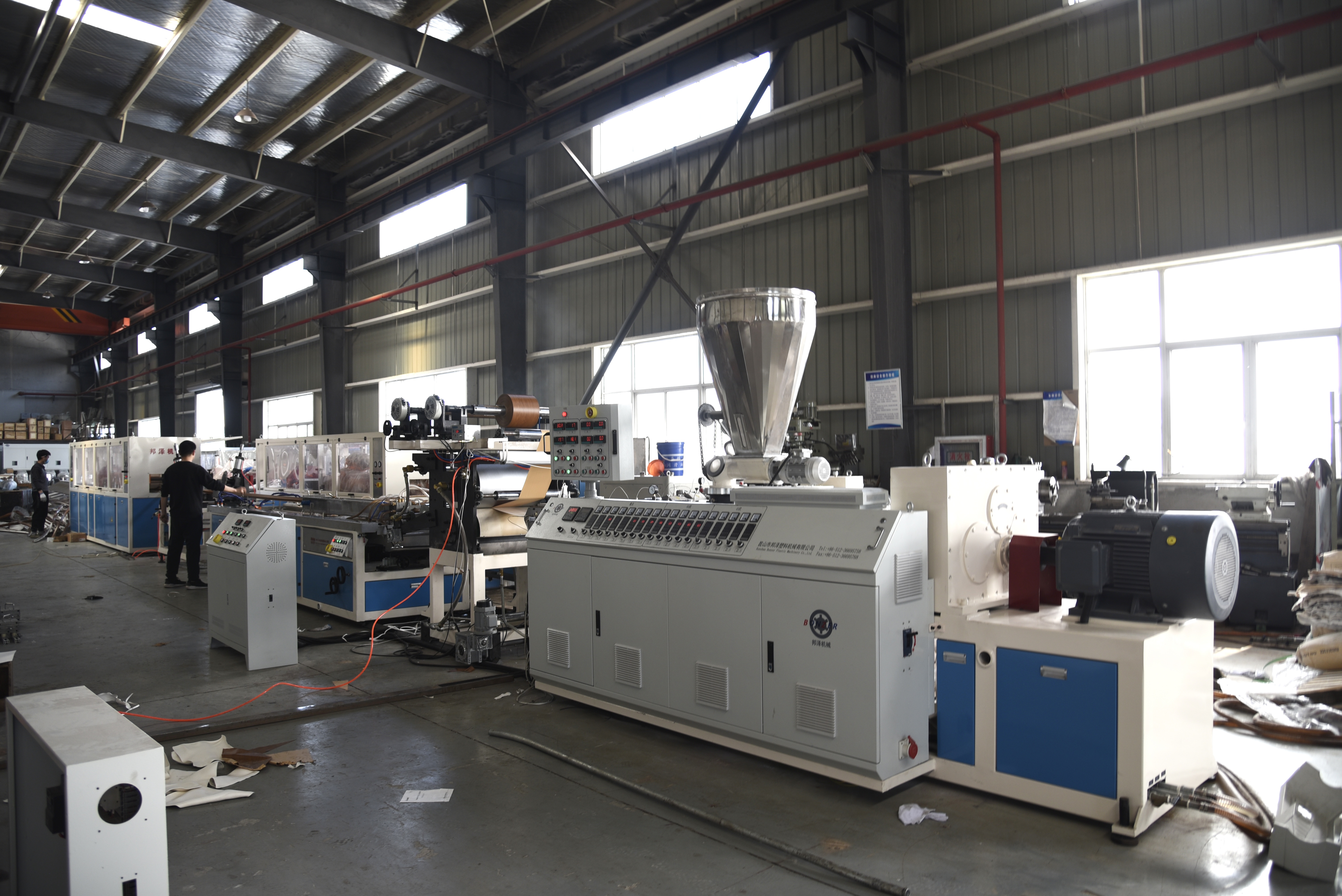
A soffit panel extrusion line is not a single machine but a fully integrated production system. It is a continuous process where raw thermoplastic compounds, primarily polyvinyl chloride (PVC) or other engineered polymers, are melted, shaped, textured, cooled, and cut to create the final profiled product. The line’s efficiency and capabilities are what allow manufacturers to produce high volumes of consistent, high-quality soffit panels. The process begins with the precise mixing of raw materials, including PVC resin, impact modifiers, heat stabilizers, pigments, and lubricants. This compound is then fed into the heart of the operation: the extruder. Understanding this holistic process is essential to appreciating how something as specific as woodgrain texture is achieved. It is the synergy between the equipment, the material science, and the process control that makes such detailed embossing possible. For building product wholesalers and contractors, recognizing the investment in such a line is a key indicator of a supplier’s commitment to quality and a primary factor in product selection for construction projects.
Before any material ever reaches the embossing stage, its journey begins with formulation. The composition of the extrudate is the fundamental building block for achieving high-definition texture. A compound designed for deep embossing requires a specific balance of ingredients. The PVC resin must be of a type that allows for excellent melt strength and flow characteristics. Impact modifiers are added to enhance durability, but their type and quantity must be carefully calibrated to not interfere with the replication of fine detail. Similarly, lubricants, both internal and external, control the friction and flow of the molten material through the die, which directly affects how it fills the intricate contours of the embossing roller. An inconsistent or poorly formulated compound will result in a melt that is either too viscous to properly fill the woodgrain pattern or too fluid, causing the fine details to slump or fade before the material sets. Therefore, the first step toward a sharper woodgrain is a rigorously controlled and consistent material recipe, ensuring a uniform melt with the exact right rheological properties for capturing detail throughout the entire soffit panel extrusion line.
The extruder itself is a marvel of thermal and mechanical engineering. Its primary function is to plasticize the solid compound into a homogeneous, molten state and then pump it consistently towards the die. This process is achieved through a rotating screw housed within a heated barrel. The screw is typically divided into three sections: the feed zone, the compression zone, and the metering zone. In the feed zone, the solid material is preheated and conveyed forward. In the compression zone, the flight depth of the screw decreases, compressing the material and melting it through a combination of conducted heat from the barrel and intense shear heat generated by the mechanical action of the screw. Finally, in the metering zone, the melt is homogenized to a precise temperature and pumped at a constant pressure and volume into the die.
The critical factor for woodgrain embossing is the uniformity of this melt. Any fluctuations in temperature or pressure will cause variations in the viscosity of the material. A non-uniform melt will not flow evenly into every microscopic groove of the embossing pattern, resulting in a blotchy and inconsistent texture. Modern soffit panel extrusion lines employ sophisticated closed-loop control systems that constantly monitor and adjust the barrel temperatures, screw speed, and melt pressure. This ensures that the material arriving at the die has a perfectly consistent viscosity, which is the essential prerequisite for replicating a deep, sharp, and uniform woodgrain pattern across the entire width and length of the panel. This level of control is a key feature sought after by those involved in procurement for building materials.
The die is a custom-manufactured block of metal that shapes the homogeneous melt into the specific profile of the soffit panel. For a hollow soffit panel, the die contains a complex series of flow channels and a mandrel to create the internal hollow chambers. The design of the die is crucial for managing the flow of the polymer melt. The goal is to have the material arrive at the die’s exit (the land area) with uniform velocity and pressure across the entire profile. If the flow is faster in the center than at the edges, the resulting panel will bow or warp. More importantly for texture, an uneven flow would mean that the material presented to the embossing rollers has varying pressure and density, making consistent embossing impossible.
Die designers use advanced flow simulation software to ensure the internal geometry of the die promotes laminar flow and eliminates any potential for stagnation. As the molten plastic emerges from the die, it is still soft and formable. It immediately enters a calibration unit, typically a vacuum calibrator, which uses a combination of cooling water and vacuum pressure to pull the soft plastic firmly against the calibrated sleeves. This process sets the outer dimensions of the panel with extreme accuracy and provides a stable, firm surface for the next critical step: embossing.
This is the stage where the visual magic happens. Immediately after calibration, the now-solidified but still-hot panel passes through the embossing station. This station consists of two large, counter-rotating rollers:
The key to successful embossing at this stage is the precise control of three factors: pressure, temperature, and timing.
The combination of a deeply and sharply engraved roller, a perfectly formulated and melted compound, and precisely controlled embossing conditions results in a panel with a woodgrain texture that is not merely printed on the surface but is physically formed into it. This deep texture woodgrain is tangible and casts authentic shadows, dramatically enhancing the realism of the product, a major advantage for exterior building product buyers.
After the embossing station, the newly textured panel enters the main cooling section of the soffit panel extrusion line. This stage is far more critical than it may seem. The embossing process applies heat and pressure to the panel, which can leave the material in a stressed state. If cooled too quickly or unevenly, the panel can warp, twist, or experience internal stresses that might later cause the detailed embossing to relax and lose some of its definition. The cooling tanks use a series of spray bars or water baths to gradually and uniformly reduce the temperature of the panel down to ambient levels. This controlled cooling “locks in” the intricate woodgrain detail, ensuring its sharpness is permanent. It ensures the dimensional stability of the product, guaranteeing that the panels will remain straight and true during shipping, storage, and installation. This final locking-in of detail is what makes the product a durable soffit solution.
Maintaining the depth and sharpness of the embossing across a production run lasting hours or days is a challenge that separates advanced extrusion lines from basic ones. Continuous quality control is integrated directly into the line. Laser scanners and vision systems can constantly monitor the panel profile for any deviations. Furthermore, line operators routinely perform manual checks using profilometers, which are instruments that can physically measure the depth of the embossed pattern. By continuously cross-referencing the output with the initial standard, operators can make micro-adjustments to the extruder temperatures, screw speed, vacuum pressure, or embosser pressure to compensate for any minor drift. This relentless pursuit of consistency ensures that the first panel produced in a run is identical to the last, providing wholesalers and contractors with the reliable, uniform product they require for large projects without fear of color or texture batch variations.
Copyright © Kunshan Bonzer Plastics Machinery Co., Ltd. All Rights Reserved. Custom Plastic Machinery Suppliers